according to madison what led to the emergence of political factions
 James Madison, author of Federalist No. 10 | |
| Author | James Madison |
|---|---|
| Language | English |
| Series | The Federalist |
| Publisher | Daily Advertiser |
| Publication appointment | November 22, 1787 |
| Media type | Newspaper |
| Preceded by | Federalist No. 9 |
| Followed by | Federalist No. 11 |
Federalist No. ten is an essay written past James Madison every bit the 10th of The Federalist Papers, a serial of essays initiated by Alexander Hamilton arguing for the ratification of the United States Constitution. Published on Nov 22, 1787, under the name "Publius", Federalist No. x is among the most highly regarded of all American political writings.[1]
No. 10 addresses the question of how to reconcile citizens with interests opposite to the rights of others or inimical to the interests of the community as a whole. Madison saw factions as inevitable due to the nature of human—that is, as long as people hold differing opinions, accept differing amounts of wealth and own differing amount of property, they will continue to form alliances with people who are most similar to them and they will sometimes work against the public interest and borrow upon the rights of others. He thus questions how to baby-sit against those dangers.[ commendation needed ]
Federalist No. 10 continues a theme begun in Federalist No. 9 and is titled "The Utility of the Spousal relationship as a Safeguard Against Domestic Faction and Insurrection". The whole series is cited by scholars and jurists every bit an administrative interpretation and explication of the meaning of the Constitution. Historians such equally Charles A. Beard fence that No. x shows an explicit rejection by the Founding Fathers of the principles of direct democracy and factionalism, and argue that Madison suggests that a representative republic is more than effective confronting partisanship and factionalism.[ii] [iii]
Madison saw the federal Constitution as providing for a "happy combination" of a democracy and a purer democracy, with "the great and aggregate interests existence referred to the national, the local and particular to the State legislatures" resulting in a decentralized governmental construction. In his view, this would brand it "more difficult for unworthy candidates to practice the barbarous arts past which elections are too often carried."
Background [edit]

Prior to the Constitution, the 13 states were bound together by the Articles of Confederation. These were, in essence, a armed services alliance betwixt sovereign nations adopted to meliorate fight the Revolutionary State of war. Congress had no power to tax, and as a event, was not able to pay debts resulting from the Revolution. Madison, George Washington, Benjamin Franklin and others feared a break-up of the union and national bankruptcy.[4] Similar Washington, Madison felt the revolution had not resolved the social problems that had triggered it, and the excesses ascribed to the King were now being repeated by the state legislatures. In this view, Shays' Rebellion, an armed uprising in Massachusetts in 1786, was simply one, admitting extreme, example of "autonomous excess" in the backwash of the War.[5]
A national convention was called for May 1787, to revise the Articles of Confederation. Madison believed that the problem was not with the Articles, but rather the land legislatures, and and then the solution was not to gear up the articles but to restrain the excesses of the states. The principal questions earlier the convention became whether usa should remain sovereign, whether sovereignty should be transferred to the national government, or whether a settlement should residuum somewhere in between.[5] Past mid-June, it was clear that the convention was drafting a new program of government around these issues—a constitution. Madison's nationalist position shifted the debate increasingly away from a position of pure state sovereignty, and toward the compromise.[6] In a debate on June 26, he said that government ought to "protect the minority of the opulent against the bulk" and that unchecked, democratic communities were subject to "the turbulency and weakness of unruly passions".[7]
Publication [edit]

Paul Leicester Ford'south summary preceding Federalist No. 10, from his 1898 edition of The Federalist
September 17, 1787 marked the signing of the final document. By its ain Article Seven, the constitution drafted by the convention needed ratification by at to the lowest degree ix of the 13 states, through special conventions held in each state. Anti-Federalist writers began to publish essays and messages arguing confronting ratification,[8] and Alexander Hamilton recruited James Madison and John Jay to write a series of pro-ratification letters in response.[9]
Like nigh of the Federalist essays and the vast majority of The Federalist Papers, No. 10 first appeared in pop newspapers. It was first printed in the Daily Advertiser under the proper name adopted by the Federalist writers, "Publius"; in this it was remarkable amid the essays of Publius, as nigh all of them first appeared in one of 2 other papers: the Contained Periodical and the New-York Parcel. Federalist No. 37, also past Madison, was the only other essay to appear beginning in the Advertiser.[10]
Because the importance afterwards ascribed to the essay, it was reprinted simply on a limited scale. On Nov 23, it appeared in the Packet and the next day in the Independent Journal. Outside New York City, it made 4 appearances in early 1788: January 2 in the Pennsylvania Gazette, January ten in the Hudson Valley Weekly, January 15 in the Lansingburgh Northern Centinel, and January 17 in the Albany Gazette. Though this number of reprintings was typical for The Federalist essays, many other essays, both Federalist and Anti-Federalist, saw much wider distribution.[eleven]
On January 1, 1788, the publishing company J. & A. McLean appear that they would publish the first 36 of the essays in a single volume. This volume, titled The Federalist, was released on March 2, 1788. George Hopkins' 1802 edition revealed that Madison, Hamilton, and Jay were the authors of the series, with 2 later on printings dividing the work by author. In 1818, James Gideon published a third edition containing corrections by Madison, who by that time had completed his ii terms as President of the United states of america.[12]
Henry B. Dawson's edition of 1863 sought to collect the original paper articles, though he did not always find the first example. It was much reprinted, admitting without his introduction.[13] Paul Leicester Ford'south 1898 edition included a tabular array of contents which summarized the essays, with the summaries again used to preface their corresponding essays. The offset date of publication and the paper name were recorded for each essay. Of modern editions, Jacob Due east. Cooke's 1961 edition is seen as authoritative, and is most used today.[14]
The question of faction [edit]
Federalist No. ten continues the word of the question broached in Hamilton's Federalist No. 9. Hamilton in that location addressed the subversive role of a faction in breaking apart the commonwealth. The question Madison answers, so, is how to eliminate the negative effects of faction. Madison defines a faction as "a number of citizens, whether amounting to a minority or majority of the whole, who are united and actuated by some common impulse of passion, or of interest, adverse to the rights of other citizens, or to the permanent and amass interests of the community."[15] He identifies the about serious source of faction to exist the diversity of stance in political life which leads to dispute over central issues such every bit what regime or religion should be preferred.
Madison argues that "the most common and durable source of factions has been the various and diff distribution of property."[16] He states, "Those who hold and those who are without property have ever formed distinct interests in lodge."[16] Providing some examples of the distinct interests, Madison identified a landed interest, a manufacturing interest, a mercantile interest, a moneyed interest, and "many lesser interests".[16] Madison insists that they all belonged to "unlike classes" that were "actuated by different sentiments and views."[16] Thus, Madison argues, these unlike classes would be prone to make decisions in their ain interest, and not for the public good. A police regarding private debts, for example, would be "a question to which the creditors are parties on one side, and the debtors on the other." To this question, and to others similar it, Madison notes that, though "justice ought to hold the residue betwixt them," the interested parties would achieve different conclusions, "neither with a sole regard to justice and the public good."
Similar the anti-Federalists who opposed him, Madison was substantially influenced by the work of Montesquieu, though Madison and Montesquieu disagreed on the question addressed in this essay. He as well relied heavily on the philosophers of the Scottish Enlightenment, especially David Hume, whose influence is most articulate in Madison's discussion of the types of faction and in his argument for an extended commonwealth.[17] [xviii]
Madison's arguments [edit]
Madison get-go theorizes that at that place are two ways to limit the damage caused by faction: either remove the causes of faction or control its effects. He then describes the two methods to remove the causes of faction: first, destroying liberty, which would piece of work because "liberty is to faction what air is to fire",[19] but it is incommunicable to perform because freedom is essential to political life, just equally air is "essential to animal life." Afterwards all, Americans fought for information technology during the American Revolution. The 2d pick, creating a gild homogeneous in opinions and interests, is impracticable. The multifariousness of the people's ability is what makes them succeed more or less, and inequality of property is a correct that the regime should protect. Madison particularly emphasizes that economic stratification prevents everyone from sharing the same opinion. Madison concludes that the impairment caused by faction can be limited only by controlling its furnishings.
He and then argues that the only trouble comes from majority factions because the principle of popular sovereignty should prevent minority factions from gaining power. Madison offers ii ways to check bulk factions: prevent the "existence of the aforementioned passion or interest in a bulk at the same time" or render a majority faction unable to act.[20] Madison concludes that a small democracy cannot avoid the dangers of bulk faction considering pocket-sized size ways that undesirable passions tin very hands spread to a majority of the people, which tin then enact its will through the democratic government without difficulty.
Madison states, "The latent causes of faction are thus sown in the nature of man",[21] so the cure is to command their furnishings. He makes an argument on how this is not possible in a pure commonwealth simply possible in a commonwealth. With pure commonwealth, he means a system in which every citizen votes directly for laws (directly democracy), and, with commonwealth, he intends a lodge in which citizens elect a small body of representatives who then vote for laws (representative commonwealth). He indicates that the voice of the people pronounced past a torso of representatives is more conformable to the interest of the community, since, again, mutual people's decisions are afflicted past their self-interest.
He then makes an argument in favor of a large democracy against a small democracy for the choice of "fit characters"[22] to represent the public'south voice. In a large republic, where the number of voters and candidates is greater, the probability to elect competent representatives is broader. The voters have a wider choice. In a small republic, it would as well be easier for the candidates to fool the voters simply more hard in a large one. The last argument Madison makes in favor of a large republic is that every bit, in a small commonwealth, there will be a lower variety of interests and parties, a majority will more oftentimes be found. The number of participants of that majority will be lower, and, since they alive in a more limited territory, information technology would be easier for them to agree and work together for the achievement of their ideas. While in a large republic the variety of interests volition be greater so to make it harder to find a majority. Even if at that place is a bulk, information technology would be harder for them to work together considering of the big number of people and the fact they are spread out in a wider territory.
A republic, Madison writes, is dissimilar from a democracy because its government is placed in the hands of delegates, and, every bit a consequence of this, it can be extended over a larger area. The idea is that, in a large republic, in that location volition be more than "fit characters" to choose from for each consul. Also, the fact that each representative is chosen from a larger constituency should make the "roughshod arts" of electioneering[22] (a reference to rhetoric) less effective. For instance, in a large republic, a decadent delegate would need to bribe many more than people in order to win an ballot than in a small-scale republic. Also, in a republic, the delegates both filter and refine the many demands of the people so as to foreclose the blazon of frivolous claims that impede purely democratic governments.
Though Madison argued for a large and diverse democracy, the writers of the Federalist Papers recognized the need for a residue. They wanted a republic diverse enough to forestall faction but with enough commonality to maintain cohesion among u.s.. In Federalist No. 2, John Jay counted every bit a approving that America possessed "one united people—a people descended from the same ancestors, the same language, professing the same religion".[23] Madison himself addresses a limitation of his determination that big constituencies will provide ameliorate representatives. He notes that if constituencies are too large, the representatives volition be "too little acquainted with all their local circumstances and lesser interests".[22] He says that this problem is partly solved past federalism. No affair how large the constituencies of federal representatives, local matters will be looked later by state and local officials with naturally smaller constituencies.
Contemporaneous counterarguments [edit]
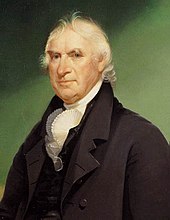
George Clinton, believed to be the Anti-Federalist author Cato
The Anti-Federalists vigorously contested the notion that a republic of various interests could survive. The writer "Cato" (some other pseudonym, near probable that of George Clinton)[24] summarized the Anti-Federalist position in the article Cato no. 3:
Whoever seriously considers the immense extent of territory comprehended inside the limits of the United states, with the variety of its climates, productions, and commerce, the departure of extent, and number of inhabitants in all; the dissimilitude of interest, morals, and policies, in most every ane, will receive it as an intuitive truth, that a consolidated republican form of government therein, can never course a perfect union, plant justice, insure domestic quiet, promote the general welfare, and secure the blessings of liberty to y'all and your posterity, for to these objects it must be directed: this unkindred legislature therefore, composed of interests opposite and dissimilar in their nature, will in its practise, emphatically exist, like a house divided confronting itself.[25]
Generally, it was their position that republics well-nigh the size of the private states could survive, only that a republic on the size of the Union would fail. A detail indicate in support of this was that most of u.s.a. were focused on one industry—to generalize, commerce and shipping in the northern states and plantation farming in the southern. The Anti-Federalist belief that the wide disparity in the economic interests of the various states would lead to controversy was mayhap realized in the American Ceremonious War, which some scholars attribute to this disparity.[26] Madison himself, in a letter to Thomas Jefferson, noted that differing economic interests had created dispute, fifty-fifty when the Constitution was being written.[27] At the convention, he peculiarly identified the stardom between the northern and southern states as a "line of discrimination" that formed "the existent departure of interests".[28]
The discussion of the platonic size for the republic was not limited to the options of individual states or encompassing union. In a letter to Richard Price, Benjamin Rush noted that "Some of our aware men who begin to despair of a more than complete marriage of united states in Congress accept secretly proposed an Eastern, Middle, and Southern Confederacy, to be united by an alliance offensive and defensive".[29]
In making their arguments, the Anti-Federalists appealed to both historical and theoretic evidence. On the theoretical side, they leaned heavily on the work of Charles de Secondat, Baron de Montesquieu. The Anti-Federalists Brutus and Cato both quoted Montesquieu on the effect of the ideal size of a republic, citing his statement in The Spirit of the Laws that:
It is natural to a republic to have just a small territory, otherwise information technology cannot long subsist. In a large republic there are men of large fortunes, and consequently of less moderation; there are trusts likewise swell to be placed in any single subject; he has interest of his own; he soon begins to think that he may be happy, corking and glorious, by oppressing his fellow citizens; and that he may raise himself to grandeur on the ruins of his land. In a large republic, the public practiced is sacrificed to a thousand views; information technology is subordinate to exceptions, and depends on accidents. In a minor one, the interest of the public is easier perceived, better understood, and more within the reach of every citizen; abuses are of less extent, and of grade are less protected.[thirty]
Hellenic republic and Rome were looked to as model republics throughout this debate,[31] and authors on both sides took Roman pseudonyms. Brutus points out that the Greek and Roman states were small, whereas the U.S. is vast. He likewise points out that the expansion of these republics resulted in a transition from costless government to tyranny.[32]
Modern assay and reaction [edit]
In the kickoff century of the American republic, No. 10 was not regarded as among the more important numbers of The Federalist. For case, in Republic in America, Alexis de Tocqueville refers specifically to more than fifty of the essays, simply No. x is non amid them.[33] Today, however, No. 10 is regarded as a seminal work of American democracy. In "The People'southward Vote", a pop survey conducted by the National Archives and Records Administration, National History Day, and U.S. News and World Study, No. x (along with Federalist No. 51, also by Madison) was called every bit the 20th about influential document in United States history.[34] David Epstein, writing in 1984, described it as amidst the most highly regarded of all American political writing.[35]
The historian Charles A. Beard identified Federalist No. x as one of the nigh important documents for understanding the Constitution. In his volume An Economic Estimation of the Constitution of the United States (1913), Beard argued that Madison produced a detailed explanation of the economic factors that lay backside the creation of the Constitution. At the showtime of his study, Bristles writes that Madison provided "a masterly statement of the theory of economic determinism in politics" (Bristles 1913, p. 15). Afterward in his study, Beard repeated his point, providing more emphasis. "The nigh philosophical examination of the foundations of political science is made by Madison in the tenth number," Beard writes. "Hither he lays down, in no uncertain language, the principle that the first and elemental concern of every authorities is economic" (Beard 1913, p. 156).
Douglass Adair attributes the increased interest in the tenth number to Beard's book. Adair also contends that Bristles's selective focus on the result of class struggle, and his political progressivism, has colored modern scholarship on the essay. Co-ordinate to Adair, Beard reads No. 10 as testify for his belief in "the Constitution as an instrument of class exploitation".[36] Adair'southward own view is that Federalist No. 10 should be read as "eighteenth-century political theory directed to an eighteenth-century problem; and ... ane of the bang-up creative achievements of that intellectual motility that later on ages have christened 'Jeffersonian democracy'".[37]
Garry Wills is a noted critic of Madison'due south argument in Federalist No. 10. In his volume Explaining America, he adopts the position of Robert Dahl in arguing that Madison's framework does not necessarily enhance the protections of minorities or ensure the common good. Instead, Wills claims: "Minorities can brand utilise of dispersed and staggered governmental mechanism to clog, delay, tiresome downward, hamper, and obstruct the bulk. But these weapons for delay are given to the minority irrespective of its factious or nonfactious graphic symbol; and they can be used against the majority irrespective of its factious or nonfactious character. What Madison prevents is non faction, just action. What he protects is not the mutual proficient but delay every bit such".[38]
Application [edit]
Federalist No. ten is sometimes cited as showing that the Founding Fathers and the constitutional framers did not intend American politics to exist partisan. For instance, U.S. Supreme Court justice John Paul Stevens cites the paper for the argument that "Parties ranked high on the list of evils that the Constitution was designed to check".[39] Justice Byron White cited the essay while discussing a California provision that forbids candidates from running as independents within one year of belongings a partisan affiliation, saying, "California plain believes with the Founding Fathers that splintered parties and unrestrained factionalism may do meaning harm to the fabric of regime."[40]
Madison's statement that restraining liberty to limit faction is an unacceptable solution has been used by opponents of entrada finance limits. Justice Clarence Thomas, for example, invoked Federalist No. 10 in a dissent confronting a ruling supporting limits on campaign contributions, writing: "The Framers preferred a political system that harnessed such faction for good, preserving liberty while also ensuring good authorities. Rather than adopting the repressive 'cure' for faction that the majority today endorses, the Framers armed individual citizens with a remedy."[41]
References [edit]
- ^ Epstein, p. 59.
- ^ Manweller 2005, p. 22.
- ^ Gustafson 1992, p. 290.
- ^ Bernstein, pp. xi–12, 81–109.
- ^ Wood, Idea, p. 104.
- ^ Stewart, p. 182.
- ^ Yates. [i]
- ^ For instance, the important Anti-Federalist authors "Cato" and "Brutus" debuted in New York papers on September 27 and October 18, 1787 respectively. Run across Furtwangler, pp. 48–49.
- ^ Ball, p. xvii.
- ^ Dates and publication information at "The Federalist", Constitution Guild. Accessed January 22, 2011.
- ^ Kaminski and Saladino, Vol XIV, p. 175.
- ^ Adair, pp. 44–46. Run into as well "The Federalist Papers: Timeline", SparkNotes. Accessed January 22, 2011.
- ^ Ford, p. xl.
- ^ Throughout Storing, for instance, and relied upon by De Pauw, pp. 202–204. For Ball, p. xlvii, information technology is the "authoritative edition" and "even so stands as the nigh consummate scholarly edition".
- ^ Federalist No. 10. p. 56 of the Dawson edition at Wikisource.
- ^ a b c d Dawson 1863, p. 58.
- ^ Cohler, pp. 148–161.
- ^ Adair, pp. 93–106.
- ^ Federalist No. 10. p. 56 of the Dawson edition at Wikisource.
- ^ Federalist No. 10. p. 60 of the Dawson edition at Wikisource.
- ^ Federalist No. 10. p. 57 of the Dawson edition at Wikisource.
- ^ a b c Federalist No. 10. p. 62 of the Dawson edition at Wikisource.
- ^ Federalist No. 2. pp. 7–viii of the Dawson edition at Wikisource.
- ^ See the accounts by, and conclusions of, Storing, Vol 1, pp. 102–104, Kaminski, p. 131, pp. 309–310, and Wood, Creation, p. 489. De Pauw, pp. 290–292, prefers Abraham Yates.
- ^ Cato, no. iii. The Founders' Constitution. Book 1, Chapter 4, Document 16. University of Chicago Printing. Retrieved Jan 22, 2011.
- ^ Bribe, Roger L. "Economics of the Civil War". Economical History Association. August 24, 2001. Referenced November 20, 2005. Citing Beard; Hacker; Egnal; Bribe and Sutch; Bensel; and McPherson, Bribe notes that "regional economic specialization ... generated very stiff regional divisions on economic issues ... economical changes in the Northern states were a major factor leading to the political collapse of the 1850s ... the sectional splits on these economic bug ... led to a growing crisis in economical policy".
- ^ Letter by Madison to Jefferson, October 24, 1787. "James Madison to Thomas Jefferson". The Founders' Constitution. Volume 1, Chapter 17, Document 22. University of Chicago Press. Retrieved January 22, 2011.
- ^ Cohler, p. 151.
- ^ Letter of the alphabet past Benjamin Rush to Richard Price, Oct 27, 1786. "Benjamin Rush to Richard Cost". The Founders' Constitution. Book 1, Chapter seven, Document 7. University of Chicago Printing. Retrieved January 22, 2011.
- ^ Montesquieu, Spirit Of Laws, ch. sixteen. vol. I, book VIII, cited in Brutus, No. one. The Founders' Constitution. Volume 1, Chapter 4, Certificate fourteen. Academy of Chicago Press. Retrieved January 22, 2011.
- ^ Yates is replete with examples.
- ^ Brutus, No. 1. The Founders' Constitution. Volume ane, Chapter iv, Document 14. Academy of Chicago Press. Retrieved January 22, 2011. "History furnishes no instance of a free republic, whatsoever thing similar the extent of the United States. The Grecian republics were of small extent; so too was that of the Romans. Both of these, information technology is true, in procedure of time, extended their conquests over large territories of country; and the consequence was, that their governments were inverse from that of free governments to those of the nigh tyrannical that always existed in the globe".
- ^ Adair, p. 110.
- ^ "The People's Vote", ourdocuments.gov, National Athenaeum and Records Administration. Retrieved January 22, 2011.
- ^ Epstein, p. 59.
- ^ Adair, pp. 120–124. Quotation at p. 123.
- ^ Adair, p. 131.
- ^ Wills, p. 195.
- ^ California Autonomous Party v. Jones, 530 U.South. 567, 592 (2000) [ii]
- ^ Storer v. Chocolate-brown, 415 U.S. 724, 736 (1974) [3]
- ^ Nixon v. Shrink Missouri Government PAC, 528 U.S. 377, 424 (2000) [4]
Secondary sources [edit]
- Adair, Douglass. "The Tenth Federalist Revisited" and "'That Politics May Exist Reduced to a Science': David Hume, James Madison and the Tenth Federalist". Fame and the Founding Fathers. Indianapolis: Liberty Fund, 1998. ISBN 978-0-86597-193-6 New York: WW Norton & Co, 1974 ISBN 978-0-393-05499-6
- Brawl, Terence. The Federalist with Letters of "Brutus". Cambridge University Press: 2003. ISBN 978-0-521-00121-2
- Beard, Charles A. An Economic Interpretation of the Constitution of the United states. New York: The MacMillan Company, 1913.
- Bernstein, Richard B. Are We to Exist a Nation? Cambridge, MA: Harvard University Press, 1987. ISBN 978-0-674-04476-0
- Cohler, Anne. Montesquieu's Comparative Politics and the Spirit of American Constitutionalism. Lawrence: University Printing of Kansas, 1988. ISBN 978-0-521-36974-9
- Dawson, Henry B., ed. The Fœderalist: A Collection of Essays, Written in Favor of the New Constitution, As Agreed Upon by the Fœderal Convention, September 17, 1787. New York: Charles Scribner, 1863.
- Epstein, David F. The Political Theory of The Federalist. Chicago: Academy of Chicago Press, 1984. ISBN 978-0-226-21300-two
- Furtwangler, Albert. The Authority of Publius: A Reading of the Federalist Papers. Ithaca, New York: Cornell University Press, 1984. ISBN 978-0-8014-1643-9
- Grant DePauw, Linda. The Eleventh Pillar: New York State and the Federal Constitution. Ithaca, New York: Cornell Academy Press, 1966. ISBN 978-0-8014-0104-6
- Gustafson, Thomas (1992). Representative Words: Politics, Literature, and the American Language, 1776–1865. Cambridge University Press. ISBN978-0-521-39512-0.
- Kaminski, John P. George Clinton: Yeoman Politician of the New Democracy. Madison: Country Historical Society of Wisconsin, 1993. ISBN 978-0-945612-17-ix
- Manweller, Mathew (2005). The People Vs. the Courts: Judicial Review and Direct Commonwealth in the American Legal System . Academica Printing, LLC. p. 22. ISBN978-1-930901-97-one.
- Morgan, Edmund S. * "Safety in Numbers: Madison, Hume, and the 10th 'Federalist,'" Huntington Library Quarterly (1986) 49#2 pp. 95–112 in JSTOR
- Stewart, David O. The Summer of 1787: The Men Who Invented the Constitution. New York: Simon & Schuster, 2007. ISBN 978-0-7432-8692-3
- Wills, Garry. Explaining America: The Federalist. New York: Penguin Books, 1982. ISBN 978-0-xiv-029839-0
- Wood, Gordon. The Creation of the American Republic, 1776–1787. Chapel Hill, NC: UNC Press, 1998. ISBN 978-0-8078-4723-7
- Woods, Gordon. The Thought of America: Reflections on the Birth of the Usa. New York: Penguin Printing, 2011. ISBN 978-1-59420-290-ii
Primary sources [edit]
- Hamilton, Alexander; Madison, James; and Jay, John. The Federalist. Edited past Jacob E. Cooke. Middletown, Conn.: Wesleyan University Printing, 1961. Wesleyan 1982 edition: ISBN 978-0-8195-6077-3
- Hamilton, Alexander; Madison, James; and Jay, John. The Federalist. Edited past Henry B. Dawson. Morrisania, New York: Charles Scribner, 1863. Accessed January 22, 2011.
- Hamilton, Alexander; Madison, James; and Jay, John. The Federalist. Edited by Paul Leicester Ford. New York: Henry Holt & Co., 1898.
- Kaminski, John P. and Saladino, Gaspare J., ed. The Documentary History of the Ratification of the Constitution. Madison: State Historical Order of Wisconsin, 1981. ISBN 978-0-87020-372-5
- Storing, Herbert J.; Dry, Murray, ed. The Complete Anti-Federalist. Vols 1–7. Chicago: University of Chicago Printing, 1981. ISBN 0-226-77566-vi
- Yates, Robert. Notes of the Secret Fence of the Federal Convention of 1787. Washington, D.C.: Templeman, 1886. Accessed January 22, 2011.
- "Storer v. Dark-brown, 415 U.Due south. 724 (1974)". Findlaw . Retrieved October i, 2005.
- "Nixon v. Shrink Missouri Regime PAC, 528 U.S. 377 (2000)". Findlaw . Retrieved August 23, 2005.
- "California Autonomous Party five. Jones, 530 U.South. 567 (2000)". Findlaw . Retrieved August 23, 2005.
External links [edit]
- Text of The Federalist No. x: congress.gov
- Online text of Brutus, no. 1, University of Chicago.
- Online text of Cato, no. three, same source as above
Source: https://en.wikipedia.org/wiki/Federalist_No._10
0 Response to "according to madison what led to the emergence of political factions"
Post a Comment